

The Success Insight
You get to define who you are. Nobody else.

The Success Insight
You get to define who you are. Nobody else.
How often do you take a step back?
J.K. Rowling wrote her first book at age six. Her parents had the view that her overactive imagination was an amusing personal quirk and would never pay a mortgage.
She studied French at the University of Exeter, and then went on to work at the research desk for Amnesty International.
This work was important to her. She described it poignantly; “I read hastily scribbled letters smuggled out of totalitarian regimes by men and women who were risking imprisonment to inform the outside world of what was happening to them.”
But she was never going to allow the work to define her. “All I ever liked about working in offices was being able to type up stories on the computer when no-one was looking.”
She described her teenage years as being filled with difficulty. When Rowling was 15, her mother was diagnosed with Multiple Sclerosis, and would die 10 years later. She described this as
“the most traumatising day of her life.”
Following her work with Amnesty, Rowling moved to Porto, Portugal, and taught English to students. She met and married Portuguese television journalist Jorge Arantes and together they had a child, Jessica.
Rowling endured domestic abuse in her relationship. She described the marriage as “short and catastrophic”. They soon separated and Rowling moved back to the UK. By this stage she already had a suitcase full of Harry Potter stories.
Without a job, Rowling lived off government welfare. “I couldn’t have written this book if I hadn’t had a few years where I’d been really as poor as it’s possible to go in the UK without being homeless,” Rowling later said.
In a 2008 interview, Rowling said she was severely depressed and sought professional help. “We’re talking suicidal thoughts here, we’re not talking ‘I’m a little bit miserable.'”
Like most aspiring authors, Rowling received a lot of rejection letters.Her book was rejected by 12 publishers.
The book was eventually accepted by Christopher Little in 1997 who made a deal to print 500 copies of “Harry Potter and the Philosopher’s Stone“. Rowling secured a £2,500 advance.
By March of 1999, 300,000 copies were sold in the UK alone. Of course, we all are now intimately familiar with the story of J.K. Rowling and the Harry Potter books.
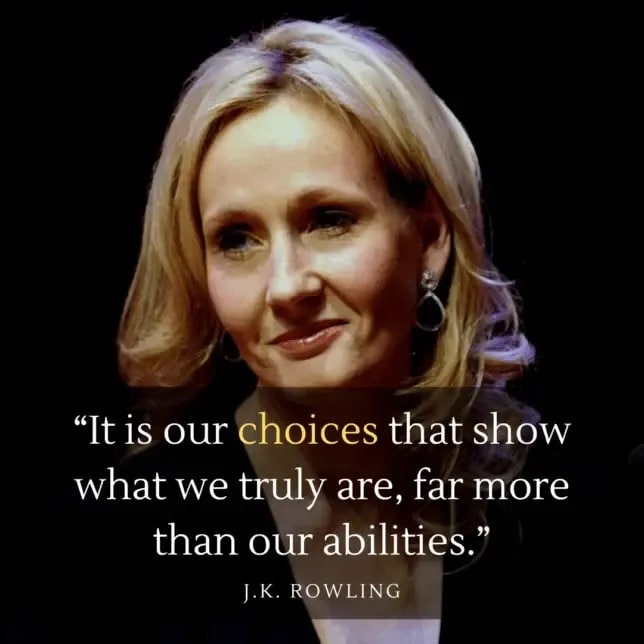
What fascinates me most about Rowling’s story, is not the rags to riches or the impact the books have had on millions of people, especially young children.
It would have been easy ” and understandable ” had Rowling settled for a steady life and allowed herself to be known as an Amnesty Researcher, or a teacher, or something else. There would be no shame in that choice. But she knew that wasn’t what interested her, and it wasn’t who she was.
Rowling knew what her passion was. She used her experiences to shape her work. For example, she was able to associate the depression she felt to describe the Dementors in her Harry Potter books.
She defined who she was. Nobody else.
You are constantly being defined (often without even knowing it).
For over 15 years I crafted a career in the corporate world. I worked on the commercial side of large IT companies. That’s a fancy way of describing sales.
It wasn’t something I dreamed of doing as child, or even planned to do as a rational career choice. It was something I fell into. Many others craft successful careers in a similar fashion.
When I began that career, I had no clue what I was doing. I remember feeling totally lost. Every day was a struggle. I thought it was crazy that I was asked to pick up the phone and speak with people (as a supposed expert) about a subject I knew very little about.
But as I applied myself over a period of time, and committed some energy, I slowly improved. It was not long before I would become proficient, and then began to excel.
And as my capability improved, my reality changed. People began to take more notice of the work I was doing and would ask me to take on greater responsibility. Simultaneously, I began to figure out how the industry worked in a broader context. My ideas and desires grew.
There’s a moment in any career when you become proficient at what you do. Industries define such increased capabilities of an individual using terms like “senior”, “established”, or other equivalent labels.
Achieving such a status doesn’t always come with an awareness. There are no bells or buzzers to let you know that you are suddenly good at what you do. And there is often nothing to officially designate your elevated proficiency.
What typically happens is that – initiated either by you or the organisation you represent – you are given a new role and job title, assume greater responsibility for the organisation’s success, and (in most scenarios) receive more money in recognition.
If you’re in a career long enough this process repeats several times. You might need to move to a different company in order to facilitate this result. I remember going through this process four or five times in my 15-year career.
But there’s a big “catch”.
Somewhere along this journey ” almost unconsciously ” you become known by the people you work with, as well as the industry you work within, and possibly your community of a friends: as a “blob”.
The “blob” could be anything. It is typically based on your achievements and experience.
It’s not always flattering. You don’t get to choose it. And the term is based more on perception than any meaningful reality.
Remember, this is a career I fell into and offered a level of commitment to. The “blob” I became known as was not an accurate description of me, my skills, my desires, or my personality.
So here I was, operating predominantly as a creature of habit, doing work I had become skilled at by accident rather than intention. When I thought about my life, I didn’t particularly like the “blob” by which I had become known.
It didn’t represent the person I wanted to be or the things I wanted to accomplish. I distinctly remember cringing my way through a conversation whenever someone took an interest in my career. It triggered many thoughts and feelings, mostly about faded dreams.
How had this happened? How had I allowed myself to get 15 years into a career, and find myself cringing at the prospect of discussing the contribution I was making to the world?
I had to break this cycle. I had to reconnect with the hopes and dreams I had as a child.
Here’s an important truth to remember….
You get to define who you are. Nobody else.
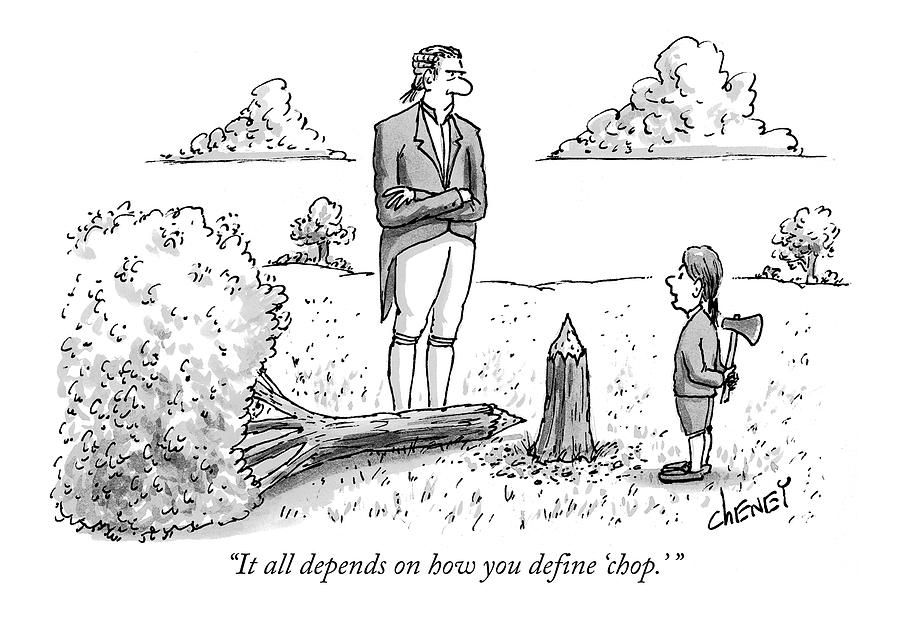
When people thought that the world was flat, it wasn’t that their thinking was distorted, it was that they were not broad sighted enough to step back far enough to see the big picture.
For centuries it was common belief that the world was flat and that you would literally “fall-off” if you crossed over the edge.
It’s difficult to comprehend how such a concept would be given any kind of credence today, given everything that we now know about our planet, our solar system, and the larger galaxy we exist within.
But it was the prevailing thought of the time. Most people accepted it without question. It’s just the way it was.
We get so close to the reality we need to survive within, we often can’t see the bigger picture.
Today, we exist in a fast-paced world. How often do you take time to step back and evaluate your life?
Given just a little probing, most people can clearly see their talents, as well as their passions.
- If you’re feeling fully connected with your passion, how often do you step back and evaluate if your days are filled with the things you love to do?
- If you’ve allowed yourself to be defined as something that is not you, how much are you willing to suffer to change that?
- And if you’re anywhere else along your journey, do you regularly take courageous risks to continue to define who you are?
Steve Jobs famously said, “You can’t connect the dots looking forward; you can only connect them looking backward. So, you have to trust that the dots will somehow connect in your future. You have to trust in something — your gut, destiny, life, karma, whatever.”
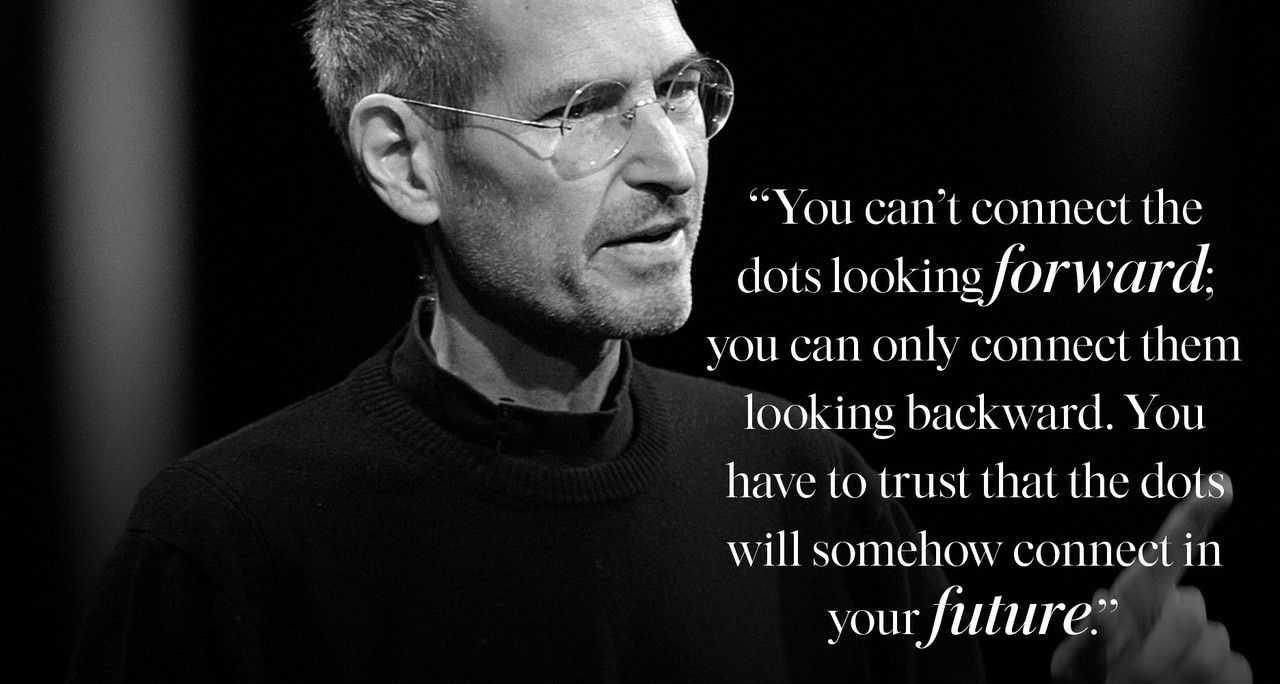
My translation of this:.